

Best eSIM for Singapore
2026 Providers and Prices
Singapore has excellent 5G coverage due to one of the most developed networks in the world. Basically, all eSIM providers are connecting to the exact same networks, so the difference users should look at is the data value for money paid, app UI, and support quality.
We compared 5 providers of Singapore eSIM and ranked them as the best: Ohayu (the lowest price), Yesim (budget-friendly plans), GigSky (free trial), Simify (simple QR setup), and Holafly (unlimited data).
Best eSIM for Singapore – Provider Snapshot
To make it easier, here are the top features for the 5 providers:
- Ohayu – cheapest 10 GB plan for $16.79, top-ups, and up to 5 reinstalls.
- Yesim – prepaid plans from $20.40 and unlimited from $6/day.
- GigSky – more costly, but good support.
- Simify – more expensive, but a clean app, easy installation.
- Holafly – unlimited plans from $3.90/day.
Singapore eSIM Providers Comparison
We compare 5 Singapore eSIM providers: Ohayu (cheapest 10 GB), Yesim (wide range of fixed and unlimited options), GigSky (free 100 MB trial), Simify (simple QR setup), and Holafly (unlimited usage). Their prices range from $16.79 for 10 GB to $74.90 for unlimited service for 30 days.
Ohayu
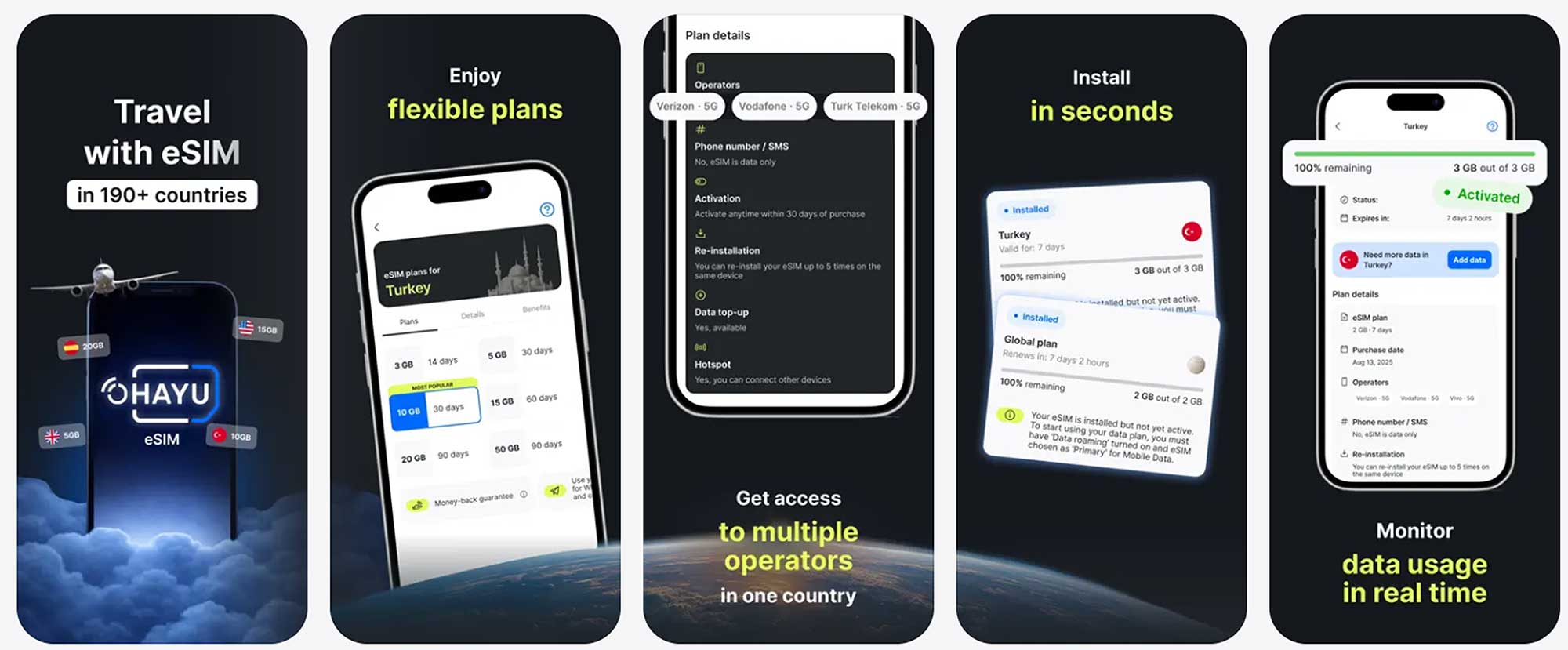
Ohayu says that they work in 190+ countries with 600+ local operators. For Singapore, it connected us to StarHub 5G, and we paid $16.79 for 10 GB, which was the cheapest among the 5 providers we tested.
The eSIM was ok, no throttling or speed limitations. Good thing that you can top up in iOS and Android apps. Ohayu also has a global plan ($9.99 for 2GB/mo) that works in Singapore, Australia, Malaysia, and 110+ other countries.
At $1.67 per gigabyte, 10 GB is enough for about a week of travel.
Benefits: automatic network switching if you travel to more than 1 country, reinstall eSIM up to 5 times if something goes wrong or it’s accidentally deleted (actually a good feature), hotspot, and human support 24/7.
Trade-off: doesn’t include local phone number or SMS.
Yesim
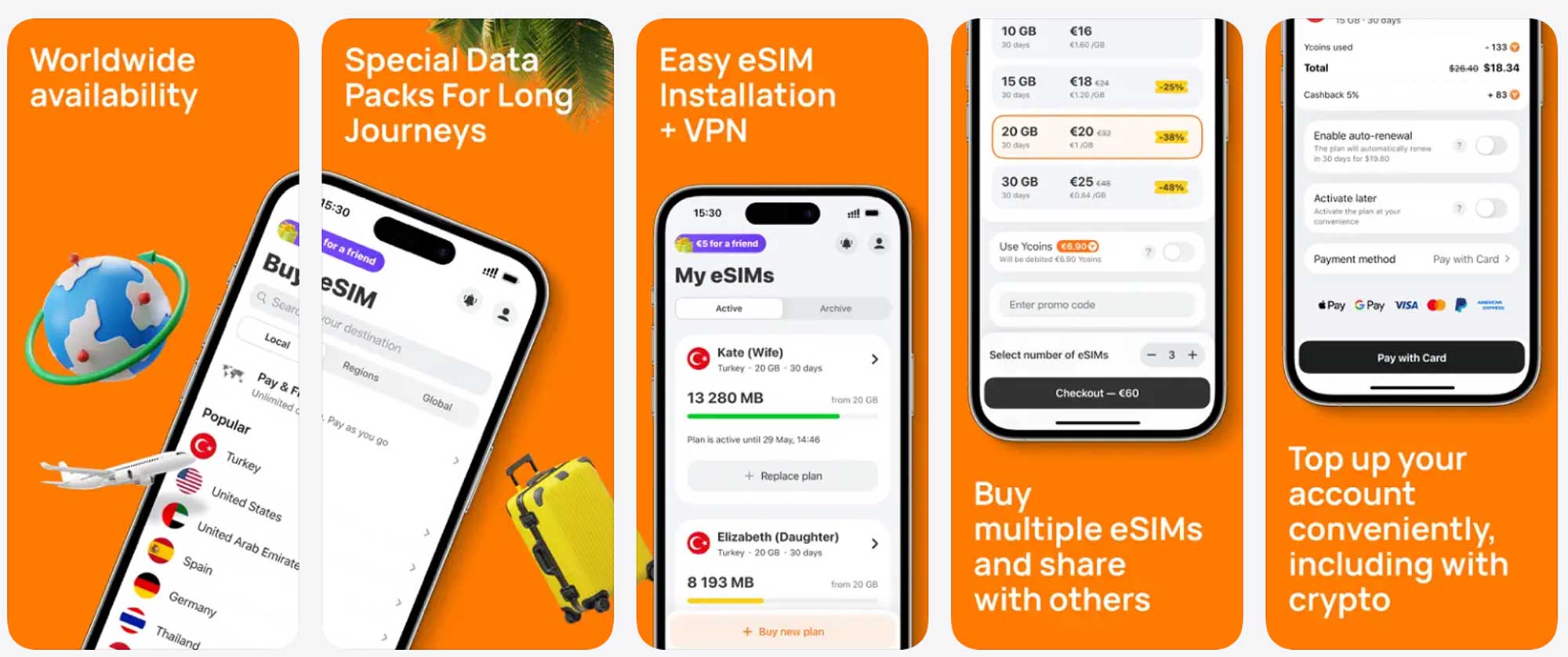
Yesim works in over 200 destinations and offers fixed and unlimited gigabytes. It uses SwitchLess technology to automatically connect to the strongest available network. In Singapore, it partners with StarHub and Singtel. The 10 GB option for 30 days costs $20.40, and you have 180 days after purchase to activate it.
When we tested ше in central Singapore, speeds stayed around 120 Mbps, and 5G worked across most of the island.
Benefits: a 180‑day activation window from purchase, top‑ups, and 24/7 support that replied to us in about 6 minutes.
Trade-offs: hotspots depend on the local operator and are not always available. Speeds can be reduced under a Fair Usage Policy, but the exact limit isn’t shared.
GigSky
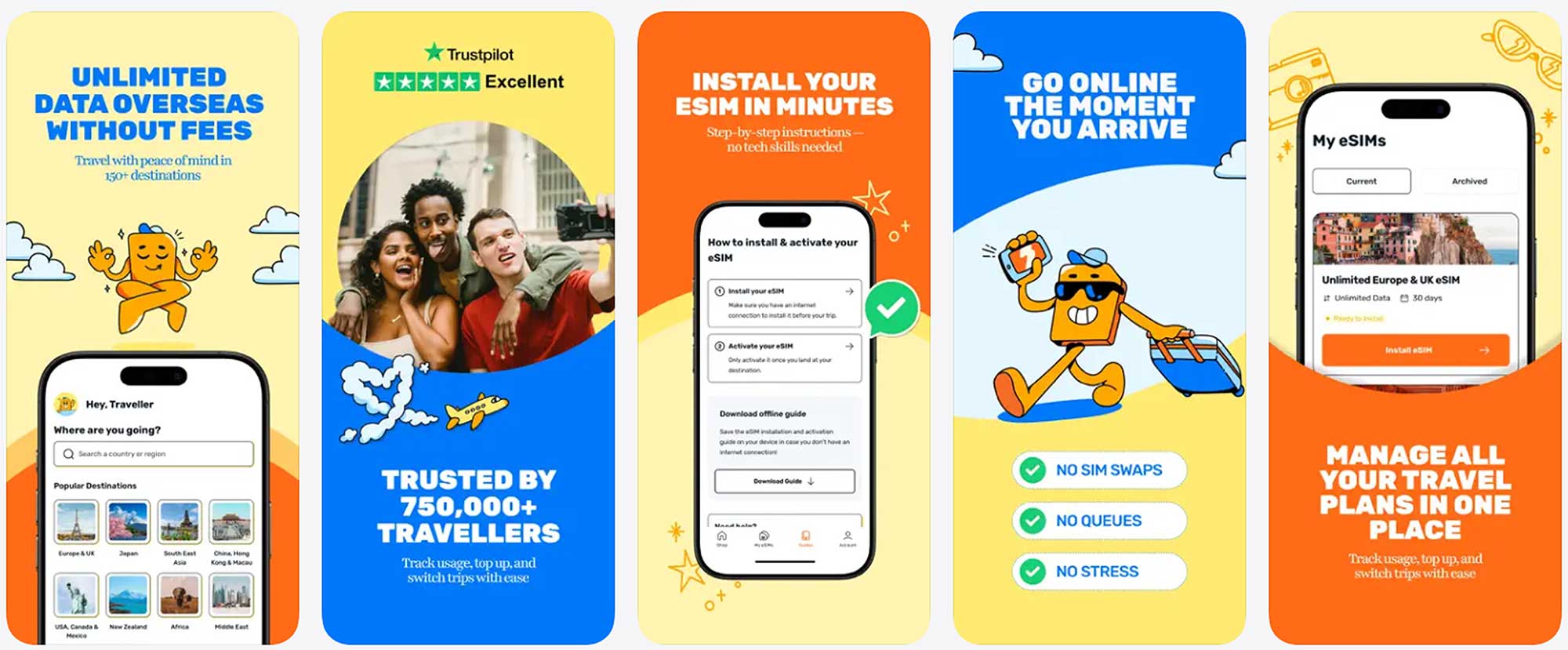
GigSky has operated since 2010 and works with 400+ mobile networks worldwide. It offers a 100 MB trial without a credit card. For Singapore, you can choose between 1 and 10 GB, valid for 7 to 30 days, with hotspot support included.
The free trial let us see how the network and app worked before we paid.
Benefits: free 100 MB trial and hotspot on all options with no extra limits.
Trade-offs: higher cost per GB (10 GB for 30 days is $84.99), no clear info on partner networks, and slower speeds on unlimited options after 2.5 GB per day.

Simify
Simify is a provider with a QR-based setup that works without an app or account. After purchase, you receive a code by email. In Singapore, Simify uses the Singtel network and offers fixed amounts from 5 to 100 GB, valid for 7 to 90 days. You can buy gigabytes up to 6 months in advance, and activation starts when you connect to a local network.
Thanks to the simple setup, we had internet as soon as we landed in the country.
Benefits: 5G/4G LTE speeds, hotspot support, and simple setup via QR code.
Trade-offs: no top-ups or recharges, so you need a new purchase if you run out of gigabytes. All options are internet-only.
Holafly
In our tests, we stayed online everywhere, including MRT tunnels, malls, and busy central areas.
Benefits: unlimited gigabytes without a cap. Hotspot sharing is included.
Trade-offs: hotspot is limited to 1 GB per day, and there are no top-ups. You need a new purchase when your days run out.

Singapore eSIM Plans Comparison
The 5 providers in this guide offer Singapore plans from $16.79 for 10 GB (Ohayu) to $84.99 for 10 GB (GigSky). They connect to Singtel and StarHub, with 5G speeds across the island.
| Provider | Supported networks | Data amount | Price for 30 days | Features |
| Ohayu | StarHub | 10 GB | $16.79 | No throttling, money-back guarantee. |
| Yesim | StarHub, Singtel | 10 GB | $20.40 | 100% refund guarantee, unlimited plans are available. |
| GigSky | Not disclosed | 10 GB | $84.99 | Free 100 MB trial, Visa card benefits. |
| Simify | Singtel | 10 GB | $28.00 | No app needed, buy up to 6 months in advance. |
| Holafly | Singtel, StarHub | Unlimited | $74.90 | Day-based pricing, monthly plans available. |
What Mobile Connection is Available in Singapore?
The country has a strong mobile network that covers the whole island, including MRT tunnels and malls. OpenSignal’s December 2025 report ranks Singtel with the most awards, StarHub with the fastest downloads at 155.9 Mbps, and M1 as the 5G speed leader.
Singapore’s position in the global mobile speed rank
The Speedtest Global Index ranked Singapore 12th globally for mobile speed in April 2026, with a median download speed of 200.37 Mbps. Here’s how it compares to other Asian countries:
| Global Rank | Country | Mobile internet speed |
| 6 | South Korea | 257.05 Mbps |
| 12 | Singapore | 200.37 Mbps |
| 14 | Vietnam | 188.15 Mbps |
| 24 | China | 158.55 Mbps |
| 29 | Malaysia | 149.36 Mbps |
| 33 | Thailand | 136.15 Mbps |
| 36 | India | 129.13 Mbps |
| 65 | Japan | 69.42 Mbps |
| 73 | Indonesia | 59.18 Mbps |
Which networks your provider uses still matters, as do throttling rules, hotspot limits, and activation window.
What to Check Before Buying an eSIM for Singapore
Network access
Some providers use a single local carrier. Others switch between two or three. Before you buy, check the provider’s country page, Reddit threads, and coverage maps like nPerf for the areas you’re going to visit.
Data amount and trip length
For a short trip, 5-10 GB is enough for maps, messaging, and social media. For longer stays or remote work, 20 GB is safer. Unlimited options are billed by the day. They cost more upfront, even if you use a small amount.
Hotspot, throttling, and limits
Most providers allow hotspot but cap how much you can share (e.g., Holafly limits it to 1 GB per day). Activation rules also differ: some options start on purchase, others on your first network connection. Check the provider’s FAQ before you buy.
How to Set Up a Singapore eSIM
Check two things before you install an eSIM: that your phone is unlocked and supports eSIM.
On iPhone, go to Settings → General → About. If you see “No SIM Restrictions” under Carrier Lock, your phone is unlocked. On Android, open Settings → Connections → Mobile Networks.
To check eSIM support, dial *#06#. If you see an EID number, your phone supports eSIM. You can also confirm this on the provider’s website.
eSIM Installation Flow for iPhone
- Buy gigabytes and get the QR code or in‑app install link.
- Open Settings → Cellular → Add eSIM.
- Scan the QR code or tap the install link.
- Set the eSIM as your mobile data line.
- Turn on roaming if your provider requires it.
Setting up eSIM on Android
- Open Settings → Connections → SIM Manager → Add eSIM.
- Scan the QR code or enter the activation code.
- Set the eSIM as the line you use for mobile internet.
- Activate roaming if your provider needs it.
Best eSIM for Singapore – FAQs
Is eSIM a good option for Singapore travel?
Yes, it works well for travel in Singapore. You install it digitally and can keep your regular SIM for calls and texts. It’s also possible to buy ahead of a trip and activate on arrival. All major networks in the country support the technology on compatible phones.
Which network is best for mobile data in Singapore?
OpenSignal’s December 2025 report ranks Singtel first overall, StarHub fastest for downloads at 155.9 Mbps, and M1 ahead in 5G speeds. All three work well in Singapore’s main tourist and business areas.
How much data do I need for a trip to Singapore?
It depends on how often you’re online and what you do on your phone. Google Maps and Grab, which are essential for getting around Singapore, use about 500 MB per day. Consider 1-2 GB per day for chats and social media. If you stream video or use a hotspot, expect 3-5 GB. For a 7‑day trip, 10 GB is enough for most people. If you work remotely or hotspot a laptop, consider 20 GB or more.
Is unlimited data worth it in Singapore?
If you plan 48 hours in Singapore or a short trip under 7 days and use your phone a lot online, an unlimited plan can make sense. For longer stays with moderate use, a 10-20 GB is usually cheaper and easier to pick. Fixed options are enough for most travelers. For example, Ohayu’s 10 GB for 30 days costs $16.79 and comfortably covers a week of moderate use. Holafly’s unlimited 30‑day plan is $74.90. It pays off only if you stream a lot or share your internet most of the day.
Can I keep my regular SIM while using a Singapore eSIM?
Yes. Most recent phones support dual usage. You can keep your home SIM for calls and texts, and use the travel option for internet. If needed, you can switch between them in your phone’s settings.
Conclusion
Singapore is an easy place to use an eSIM. Coverage is wide across the island, and all major networks support it. The main differences between providers are networks, number of gigabytes, pricing, and limits, such as hotspot and throttling
Ohayu suits budget-conscious travelers with the cheapest 10 GB at $16.79. Yesim is an option if you want flexibility, as it offers fixed and unlimited options on StarHub and Singtel. GigSky is practical if you want to test the service before paying, thanks to its free trial. Simify is for travelers who prefer a simple QR code setup without installing an app. Holafly suits heavy users who want unlimited internet on Singtel and StarHub.