

The King Abdullah Economic City Sands and the Madinah Date Groves:
Mapping the Desert Corridor
The coast near King Abdullah Economic City does not feel ancient at first glance. The sand is pale, almost reflective. Buildings rise in measured lines, glass catching sun before returning it to the sea. Roads curve with deliberate smoothness. Everything appears recently drawn.
Yet the desert does not disappear just because towers stand near it. It waits beyond the edges — in flat stretches where wind rearranges the surface quietly, in the heat that gathers above pavement before midday.
The Red Sea remains constant, indifferent to construction.
Where Steel Crosses Sand
The transition inland begins almost imperceptibly. The coastline loosens, dunes widen, and the horizon becomes uninterrupted. There is a steadiness to the land that does not invite drama. It stretches rather than rises.
From the station, the Haramain trains cut across this corridor with a precision that feels almost delicate against the scale of open desert. The carriages remain cool while the exterior world shimmers. The movement is fast, but not aggressive. Sand gives way to rock, then to stretches of earth that appear unmarked.
Inside the carriage, silence settles easily. The view does most of the speaking. Occasional infrastructure appears — a distant overpass, a service road — then vanishes again into brightness.
Nothing here feels ornamental. The desert absorbs contrast.
Groves in Ordered Shade
Approaching Madinah, the land shifts in tone rather than form. Date palms appear first as scattered vertical lines, then in denser arrangements. Their trunks create narrow shadows that stretch unevenly across dry ground.
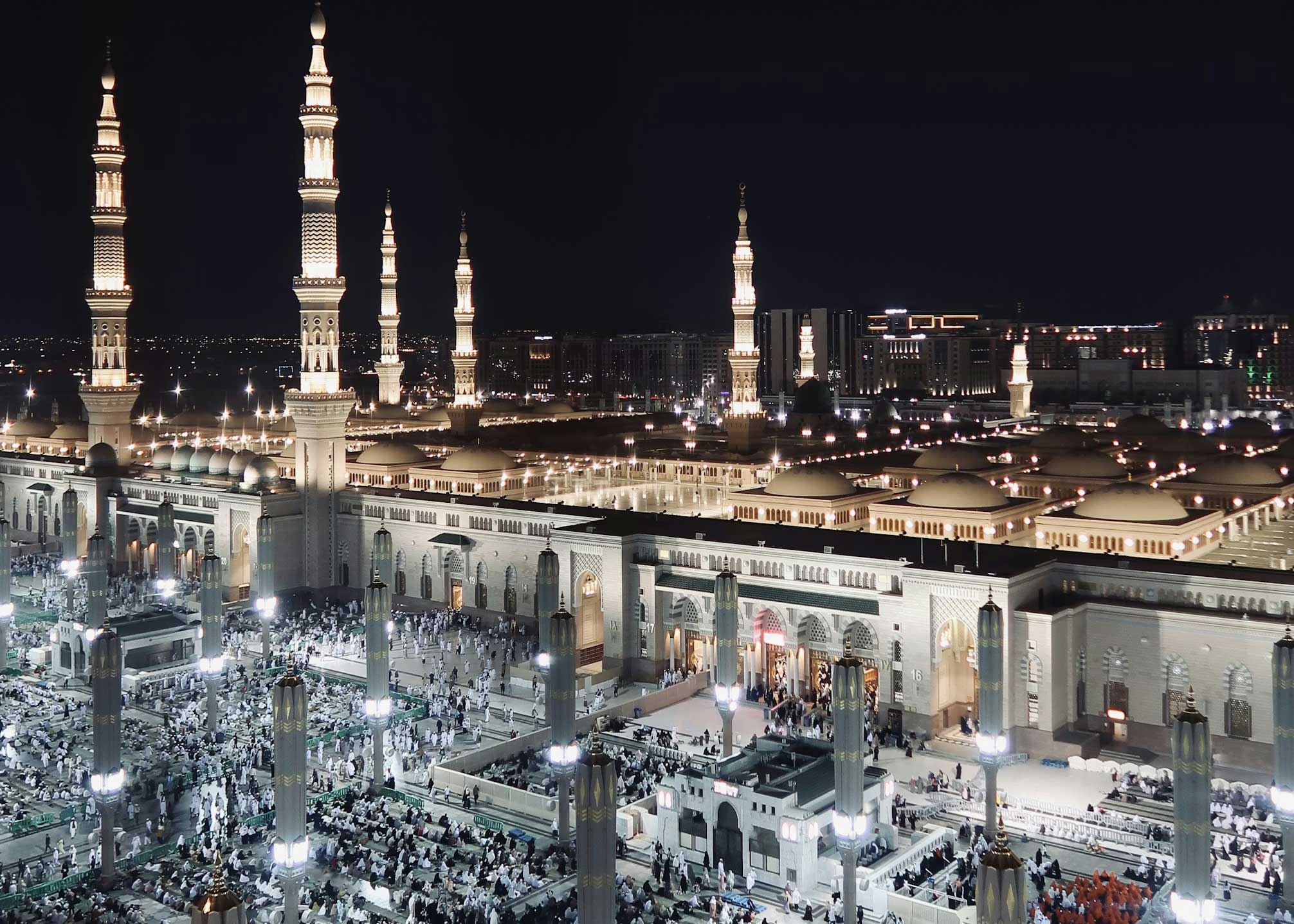
The city gathers gently. Minarets rise without crowding one another. The Prophet’s Mosque stands at the centre, but the surrounding streets do not press too tightly against it. There is space to breathe.
Within the date groves, the temperature changes subtly. Shade deepens. The air feels heavier but less exposed. The geometry of planted rows introduces order into terrain that otherwise resists structure.
The contrast between the coastal development and the cultivated groves is not stark. Both rely on design. One vertical in glass and concrete, the other vertical in living trunks and leaves.
The Line Between Them
The desert corridor linking King Abdullah Economic City and Madinah does not dramatise the distance. It presents it in wide bands of light and muted colour. The rail line becomes a thin thread across a vast surface.
From the window, you begin to notice small variations — a cluster of shrubs resisting dryness, a patch of darker soil, a solitary structure standing at an angle against wind.
The train does not linger. It moves with consistency. The desert remains patient.
When the Heat Softens
By late afternoon, the sand near the coast takes on a warmer hue. In Madinah, the date palms hold light along their fronds before it fades. Surfaces release stored warmth slowly.
Nothing resolves into contrast. The economic city continues to build upward. The groves continue to grow outward. The desert between them remains expansive and largely unchanged.
Steel passes across sand. Roots hold the soil. The corridor does not choose between them.
It simply allows both to exist along the same line of travel, where modern construction and cultivated tradition meet under a sky that remains larger than either.